
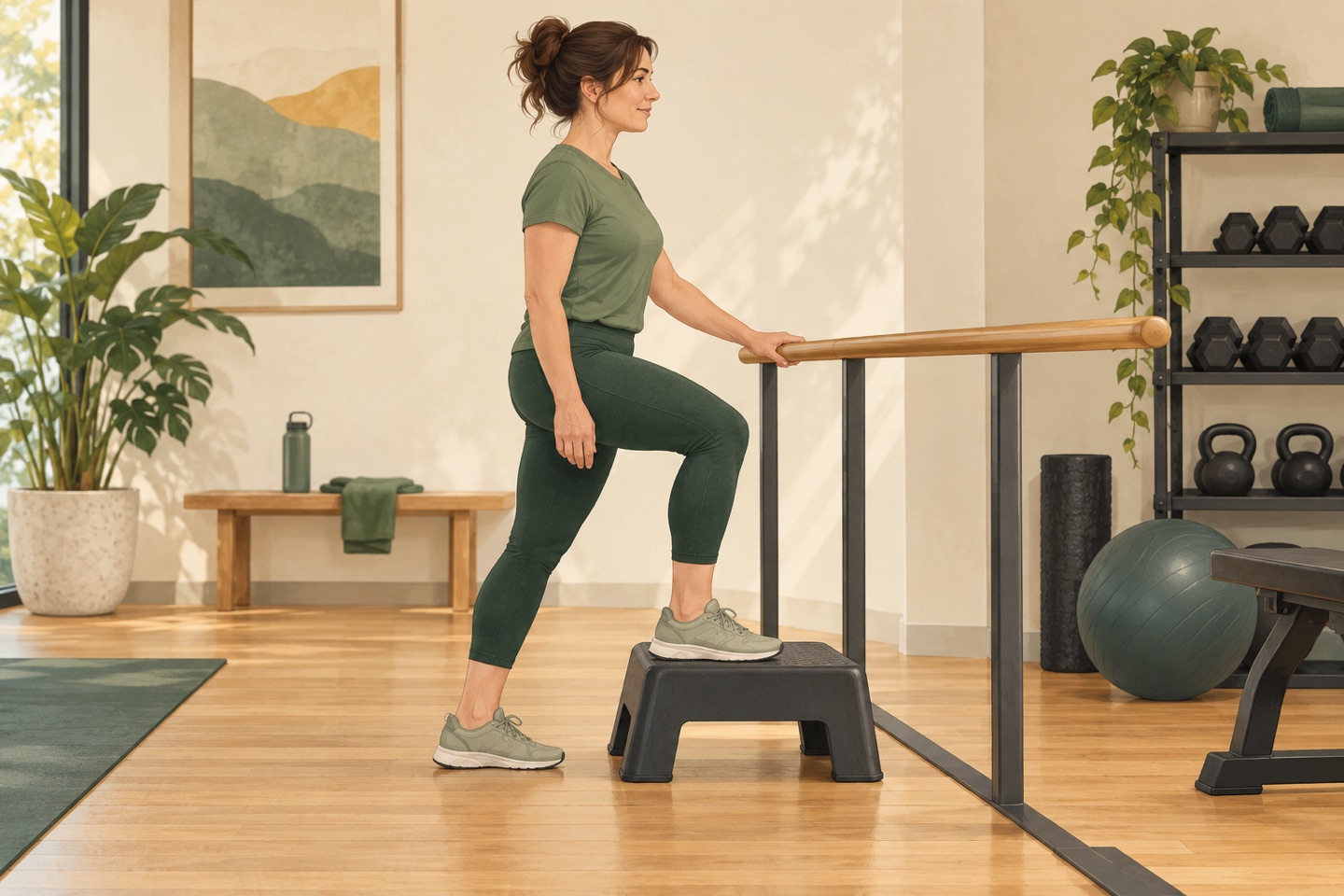
There was no twist, fall or memorable incident. Your knee started hurting on the stairs. Then during squats. Now you plan your day around avoiding both.
Pain around or behind the kneecap often fits a condition called patellofemoral pain. The name describes the area. It does not explain your entire knee.
Does this pattern fit patellofemoral pain?
Squats, stairs and other activities involving a bent, loaded knee often provoke patellofemoral pain. An examination checks whether this pattern fits and whether another problem explains the symptoms. [1]
Front-of-knee pain is not always the same condition. Tendon pain, joint injury and other causes require different decisions. The location alone is insufficient.
A knee which rapidly swells after an injury, will not straighten or repeatedly gives way needs assessment. A hot, red, swollen knee with fever or feeling unwell needs urgent medical care. A child or teenager with knee pain and a limp also needs prompt assessment. [3][4]
Why do stairs and squats hurt?
Your kneecap forms a joint with the thigh bone and helps your thigh muscles work through the knee. Squatting and using stairs place demands on this system. Depth, resistance, repetitions and how often you repeat the task all matter.
Changing one of those demands gives you a practical way to adjust an exercise. It does not mean your kneecap is out of place or your knee is wearing out. Those explanations require evidence from your assessment.
Review the month before symptoms appeared. More hills, a new running plan, high-repetition lunges, a walking holiday or extra flights of stairs are useful details. So are previous episodes and changes elsewhere in your training.
What has the best support?
The 2024 best practice guide places exercise and education at the centre of care. Knee-focused exercise, with hip-focused exercise where appropriate, forms the main treatment. The guide drew on 65 high-quality trials involving 3,796 participants, alongside patient views and expert reasoning. [2]
This does not produce one exercise sheet for everyone. Exercise choice should reflect your strength, symptoms, current activity and the tasks you want to return to.
Train the knee
Choose a tolerated squat, step, leg press or knee-extension exercise.
Include the hip where useful
Hip exercise complements the plan. It does not replace every knee exercise.
Make the dose clear
Know what to do, how often and which response means a review.
Taping, prefabricated shoe inserts and movement changes are supporting options for selected people. Their role is to help you do useful activity. They are not a replacement for the exercise plan. [2]
Keep the task, adjust its dose
Avoiding every sore movement leaves you without a way to rebuild it. Repeating the same painful dose also gets you nowhere. Find a manageable version.

| Your task | A possible adjustment |
|---|---|
| Squats hurt at the bottom | Use a higher box or shorten the range, then rebuild depth. |
| Repeated stairs aggravate symptoms | Use the handrail and reduce unnecessary repeated trips. |
| Running hills leaves you sore | Compare a flatter route or reduce the session dose. |
| Long sitting is uncomfortable | Change position or straighten the knee periodically. |
There is no single correct squat style for every sore knee. Compare options which let you move with control. A temporary adjustment is a starting point, not a permanent restriction.
Judge more than the exercise itself
A comfortable session followed by a difficult evening is useful feedback. So is a session which causes some discomfort but leaves daily tasks unchanged.
Record the exercise and dose, symptoms during it, your response later and how stairs or walking feel the next day. This helps you and your physiotherapist decide whether to hold, progress or reduce the work.

A universal pain limit is less useful than a clear plan for your knee. New swelling, locking or instability changes the discussion.
What does progress look like?
Choose a task you care about: your home stairs, a squat depth, a walking route or part of a run. Compare it over time alongside your exercise work.
Progress means doing more of the task with a manageable response. One pain-free afternoon is encouraging. It does not establish readiness for a large increase in running or gym volume.
There is no fixed recovery date for every knee. If the diagnosis is unclear, symptoms persist or the plan keeps provoking a flare, get it reviewed. The answer should be more useful than another collection of exercises.
Read more about knee pain assessment at Bridge Road Physiotherapy.
Knee pain getting in the way?
Book an assessment at Bridge Road Physiotherapy, inside Uplift Gym at 507 Bridge Road, Richmond. We’ll review the problem, your current activity and the next steps for your rehabilitation.
References and further reading
- Willy RW, et al. Patellofemoral pain: clinical practice guidelines. JOSPT. 2019;49:CPG1–CPG95. Read the source.
- Neal BS, Lack SD, Bartholomew C, Morrissey D. Best practice guide for patellofemoral pain based on synthesis of a systematic review, the patient voice and expert clinical reasoning. BJSM. 2024;58:1486–1495. Read the source.
- NHS. Knee pain: symptoms needing urgent care. Read the source.
- Royal Children’s Hospital Melbourne. The limping or non-weight bearing child. Clinical Practice Guidelines. Read the source.
General education. An individual assessment is needed to diagnose your symptoms and choose appropriate care.