
An awkward kerb, a landing on someone else’s foot or a missed stair. Your ankle rolls, swells and makes ordinary walking difficult.
The first decision is whether this needs medical assessment. The next is how to rebuild it. Waiting for the bruising to disappear is not the whole rehabilitation plan.
Does it need assessment today?
Get assessed promptly if you are unable to take four steps, have marked pain over bone, or have pain above the ankle between the shin bones. A sprain, fracture and higher ankle injury need different plans.
Clinicians use the Ottawa ankle rules to help decide whether an ankle or foot X-ray is needed. They combine the location of pain with tenderness at specific bony points, or inability to bear weight immediately after injury and during assessment. The ankle and midfoot have separate criteria. [1]
These are clinical decision rules, not a home test proving the ankle is fine. They do not assess every ligament, tendon or cartilage injury. Walking on an injured ankle does not rule out every fracture.
Bruising does not set the timetable
Swelling, bruising, tenderness, walking ability and stability all inform assessment. The first examination is sometimes limited by pain. A review after the initial swelling settles helps refine the plan. [2]
There is no recovery deadline shared by every sprain. A mild injury and a severe ligament injury should not receive the same instructions because both happened on Saturday.
The first few days: protect without forgetting movement
The 2021 clinical guideline supports external support and progressive weight bearing for an acute lateral ankle sprain. The amount of support depends on the severity and your ability to walk. Severe injuries sometimes need a short period of immobilisation under clinical guidance. [3]
| What you need | What it means |
|---|---|
| Protection | Avoid the movements which stress the injury. A brace, tape or walking aid is selected to your needs. |
| Supported walking | Build weight bearing as tolerated rather than forcing a pronounced limp. |
| Comfort | Elevation or compression is an option. Support should not produce numbness or colour changes. |
| Pain relief | Ask a pharmacist or doctor about suitable medicines and your medical history. |
Ice is an option for short-term comfort if used safely. It is not a substitute for assessment or exercise. Medicine decisions should not come from an acronym on a social media post.
The first fortnight: build useful function
Once the injury and protection needs are clear, rehabilitation should include movement, exercise and balance. The dose changes with your symptoms and examination. [2][3]

For an uncomplicated sprain, a physiotherapist might begin with ankle movements within a tolerated range, supported walking and simple strength work. Calf raises and balance tasks progress as function improves.
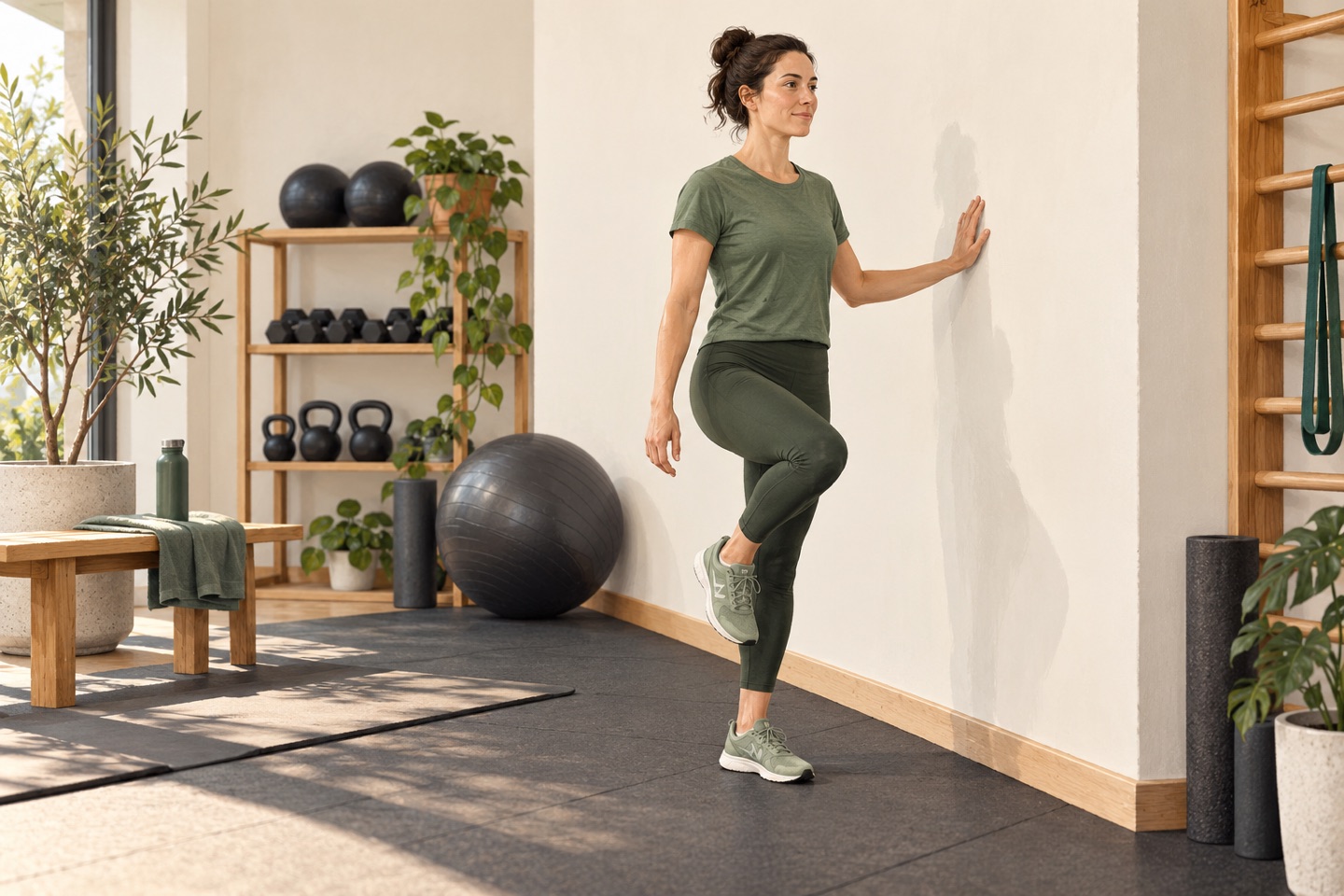
Choose balance tasks beside a stable support. Start with eyes open. Making the task harder is useful only when you control the current version. Closing your eyes while wobbling beside furniture adds a problem you did not need.
Suitable conditioning also belongs in the plan. The choice depends on the injury and the response, rather than a rule to start cycling or swimming on a particular day.
What should you monitor?
Walking
Are you moving more comfortably with less reliance on support?
Response
Does the exercise dose leave swelling, pain or function worse later?
Control
Are movement, strength and balance improving over repeated sessions?
If symptoms or function deteriorate, get reassessed. Persistent inability to bear weight, worsening swelling, unusual pain or repeated giving way deserves review. An ankle which is not progressing needs a clearer explanation than “give it time”.
Walking is one step. Sport asks for more.
Sport adds hopping, landing, running and rapid changes of direction. The PAASS expert consensus organises return-to-sport assessment into five areas: pain, ankle impairments, your confidence, balance and control, and sport performance. [4]

Feeling fine on a short walk is encouraging. It does not show readiness for a full netball match or football training. Prepare for the actual tasks and review the response to a full session.
Bracing or taping is useful for reducing repeat-sprain risk in appropriate sporting situations. It complements rehabilitation rather than replacing strength and balance work. [3]
Read more about ankle injury assessment and rehabilitation in Richmond.
Need a clear ankle rehabilitation plan?
Book an assessment at Bridge Road Physiotherapy, inside Uplift Gym at 507 Bridge Road, Richmond. We’ll review the problem, your current activity and the next steps for your rehabilitation.
References and further reading
- Bachmann LM, et al. Accuracy of Ottawa ankle rules to exclude fractures of the ankle and mid-foot: systematic review. BMJ. 2003;326:417–419. Read the source.
- Vuurberg G, et al. Diagnosis, treatment and prevention of ankle sprains: update of an evidence-based clinical guideline. BJSM. 2018;52:956. Read the source.
- Martin RL, et al. Ankle stability and movement coordination impairments: lateral ankle ligament sprains revision 2021. JOSPT. 2021;51:CPG1–CPG80. Read the source.
- Smith MD, et al. Return to sport decisions after an acute lateral ankle sprain injury: introducing the PAASS framework. BJSM. 2021;55:1270–1276. Read the source.
General education. An individual assessment is needed to diagnose your symptoms and choose appropriate care.